

[ad_1]
We are informed by an ancient fable that Ixion was invited by Jupiter to a banquet, fell in love, and began to court Juno herself; offering to embrace her, he clasped a cloud, from whence the Centaurs proceeded, by nature half men, half horses, a fierce, a fighting, and unquiet generation, the source of all contention and bloodshed
—Thomas Hobbes, De Cive (1641)
Born into one world, yet longing to live in another, man stumbles as he jumps, then settles in awkwardly between the two worlds, a discontented and dangerous halfway creature. Therein lies his ruin. To what examples might we allude for confirmation?
Anticipating the catastrophe of the English Civil War, Hobbes (see above) proposed that its cause would lay in man’s inability to accept that justice exceeds mortal grasp. Man cannot jump that high. Purporting nevertheless to be able to achieve a Divine vantage point on the matter, English citizens would give birth to monstrous ideas about justice. Monstrous crimes followed.
Consider Plato’s Republic. Positioned halfway between darkness and light, man dwells in a cave-like world, amidst shadows, neither quite alive nor dead, neither ignorant nor knowledgeable, swayed by the half-truth of opinion. Misunderstanding where real substance lies, he seeks instead to possess all things among the shadows and, so, succumbs to tyranny. Thrasymachus is everyman.
Consider Tocqueville’s Democracy in America. Dwelling halfway between the aristocratic age and the democratic age, man alternates between looking back longingly with the hope of reenchanting the world; and looking forward, with revolutionary rage, to abolishing the past and the present altogether. Here are the conservatives and the radicals, at war with each other, but alike in their inability to live without thorough-going parsimony, as a good liberal must be able to do.
Consider Nietzsche, in his assorted writings on the genealogy and fate of Europe. Claiming to have overcome Christian religion via the Enlightenment, European man nevertheless remains halfway Christian, adhering to Christian moral claims about equality, though now dissevered from Christian religion. “It is the church, and not its poison, that offends us,” European man declares. Unable to fully destroy the Old Tablets, so that new ones may be written, European man is suffocating from the Christianity he thinks he has renounced. Ensnared halfway between a Christian past to which he cannot return and a truly post-Christian future he dares not embrace, European man has no basis for believing anything and, so, he “feeds parasitically on every civilization under the sun,” in a multicultural orgy that masks a hunger he cannot sate.
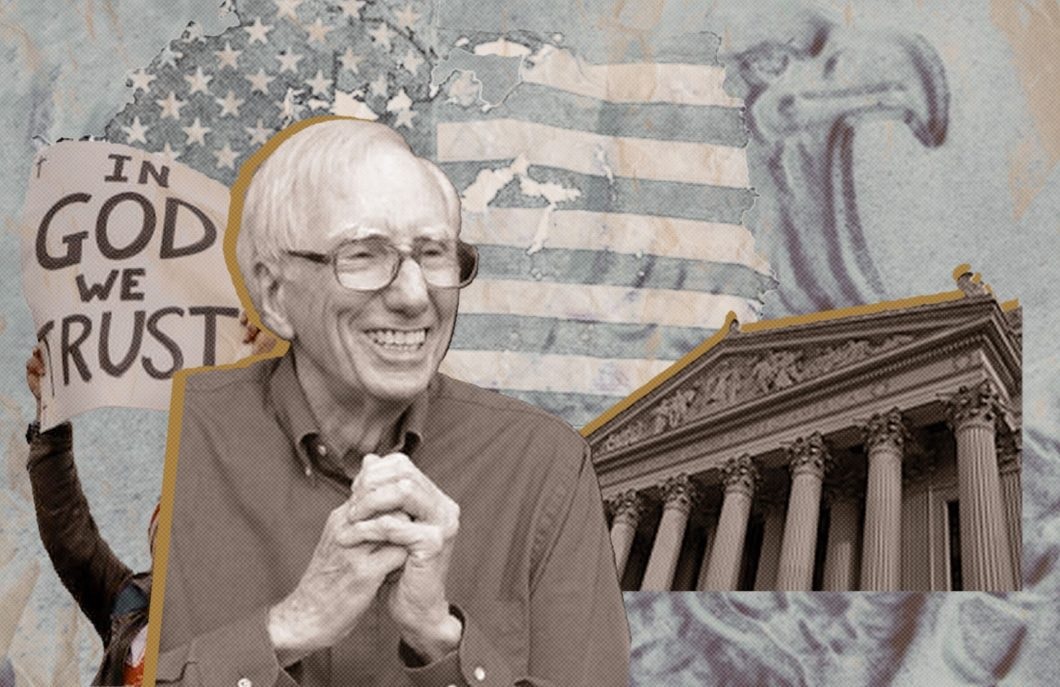
What shall we make of civil religion? Is it, too, a tempting halfway measure, alternatingly dangerous and impotent, “operating in a realm distinct from both church and state, though borrowing from both,” as Richard Gamble writes in this fine essay about civil religion as it was crafted by Robert Bellah? Many of us know of Robert Bellah the sociologist, who is his classic work, The Habits of the Heart, carved out a halfway position between Weber and Tocqueville, declaring at one moment that the world has succumbed to the instrumental rationality of the former, and at the next moment that only the civic institutions defended by latter can save us. Gamble’s fine-grained account of Bellah, an advocate of American civil religion in the late twentieth century, is a welcome point of departure for us to re-engage a question that has loomed over America since she has come to occupy a halfway position that is neither fully Christian nor quite post-Christian.
This haunting question is, for us today, more than merely scholarly. The political left increasingly has both Christian ideas and the churches that profess them in its figurative gun sights; and in the wake of the near collapse, on the political right, of Reagan free-marketism and Bush II neo-conservatism, an emerging chorus of public intellectuals, courageously or recklessly, depending on your judgment of the matter, ponder a return to pre-modern political Catholicism of early modern Reformation nationalism. For us today, the question is whether a civil religion can bring coherence and purpose to a nation that seems on the verge of being torn asunder. If it cannot, as so many of us suspect, what next? Are we seeing the beginning of the mobilization for war between those on the left who want to destroy every vestige of Christianity, so that the world it has stained may be bleached clean; and those on the right who believe that without the whole cloth of Christianity, our nation cannot endure?
That a nation, to be a nation, needs an account of its position in the order and history of the cosmos, has been a truism for all of recorded history. Mythos precedes logos. Plato’s rational coherence is enframed by the mercilessness of Homer’s gods on the battlefields of Troy, and by the Dionysian revelry Nietzsche later tried to retrieve. Roman concrete is alloyed with the blood spilt in the deathmatch between Romulus and Remus. As childhood fables precede adult problem-solving, so, too, do religious accounts—on which thought reflects, but behind which thought cannot go—precede and channel the thinking of the citizens of a nation. The story guides the thought, and perhaps forms it, too. That is why, in Democracy in America, Tocqueville wrote:
Religion, which never intervenes directly in the government of American society, should be considered as the first of their political institutions, for although it did not give them taste for liberty, it singularly facilitates their use thereof.
In triumphal accounts of the development of the West, Christianity displaced Mediterranean and European paganism, and then European Enlightenment superseded European Christianity. These triumphs were, of course, never complete: Christianity never fully erased paganism; and the Enlightenment never fully erased Christianity. In the shadow of Calvin’s Geneva, Rousseau tacitly adopted the triumphalist position, which had stark implications for the post-Christian polis: as Christian religion receded, a civil religion would have to take its place. So, he insisted in The Social Contract. The Christians of Europe were suspicious. Christians in America today are doubly so, because insofar as civil religion has had a purchase in America it has not simply been a stand-in for Christianity; its content has borrowed from Christianity. As Gamble puts it:
Does the Bible and its message of eternal life survive this kind of appropriation? Does it show the social utility of the Bible and the Jewish and Christian faiths at the cost of what Scripture is really about?
How is such an appropriation possible, and what are its limits? The blood sacrifice of the Civil War, through which the Christian symbolism of death, sacrifice, and rebirth, was “made flesh” (John 1:14) as American civil religion, points in the direction of an answer to this important question. To understand it, we need to specify the way civil religion and Christianity are related. Rousseau thought of it as a replacement—a substitute—for Christianity. So, too, do many political theorists today.
A reinvigorated American civil religion will require nothing less than the reinvigoration of the churches of America.
A subtler way to think of the relationship is that civil religion is a supplement to Christianity, but cannot be a substitute, no less than vitamins can supplement a meal, but not be a substitute for it. The supplement to the meal is separate from the meal and derives its ability to amplify and heal only so long as its referent (meal) remains intact. Absent the meal, the supplement’s power is lost.
So, too, with our American civil religion, inaugurated by Lincoln, in the aftermath of the Civil War. It was a supplement to the Christian symbolism of death, sacrifice, and rebirth, whose capacity to bind a nation required that the background meal of Christianity, however formally distant and distinct from national politics, be present. American civil religion appears to be separate from and independent of Christianity, yet is it separate in the same manner as the supplement appears to be separate from and independent of the meal. It cannot wander far from the meal and retain its power to sustain and heal. Insofar as it does wander off, insofar as it purports to be a substitute for, rather than a supplement to, the meal, it becomes impotent.
A supplemental civil religion can never become a substitutionary offering that stands in for Christian religion. This means that civil religion, inaugurated in thought by Rousseau in The Social Contract, in the hope of binding the nation together in the Age of Enlightenment, can supplement but not substitute for Christianity. American civil religion after the Civil War achieved its supplemental power against the backdrop of the Christian symbolism of death, sacrifice, and rebirth; Rousseau’s civil religion, we should not be surprised to learn, achieves its supplemental power against the backdrop meal of Christianity as well—in his case, through a morality that is strikingly similar to Christianity, upheld by a god-like sovereign, who stands, shepherd-like, over a citizenry bound by a general will through which “power is made perfect in weakness” (2 Cor. 12:9).
In America today, we witness the weakening of our civil religion, not incidentally, in proportion as Christianity itself is weakened or deformed. The political left celebrates the weakening of both Christianity and its supplement. Some on the political left, the middle, and on the political right see the need for a civil religion and believe it possible to uphold in a post-Christian age. That is not going to be possible. A third group, on the political right, dream of a fully Christian America—of an America whose religion is vouchsafed by political power. In implementing that dream, we will awaken to a nightmare. Tocqueville’s warning is one we must heed: neither pre-modern political Catholicism nor early modern Reformation nationalism can save us.
Our problem is not as Bellah imagines it to be. He worried about the disenchantment of the world and the absence of a binding understanding, common to all, that can arrest the centrifugal forces that send us into our own solitary universes. Our problem is the heresy of identity politics, which draws from Christianity the idea of irredeemable stain, the innocent victim, and the scapegoat who, if purged, will take away the sins of the world. Far from being a centrifugal force within America, identity politics parishioners have constructed what amounts to an Establishment Church, which binds them tightly together in a liturgy that involves scapegoating those whose irredeemable stain condemns them to outer darkness. This profound deformation of Christianity, this heresy, cannot be addressed by (re)turning to pre-modern political Catholicism or to early modern Reformation nationalism. This is a problem that the churches alone can solve—by inviting the heretics back in, and showing them that the churches have a superior way to understand irredeemable stain, the (one) Innocent Victim, and the (Divine) scapegoat.
To this we must add that a reinvigorated American civil religion will require nothing less than the reinvigoration of the churches of America. Having accomplished the latter, we will be happily surprised to learn that American civil religion, which can, in fact, include more than confessional Christians, is the supplement that binds and strengthens our republic.
[ad_2]
